 Frenchie
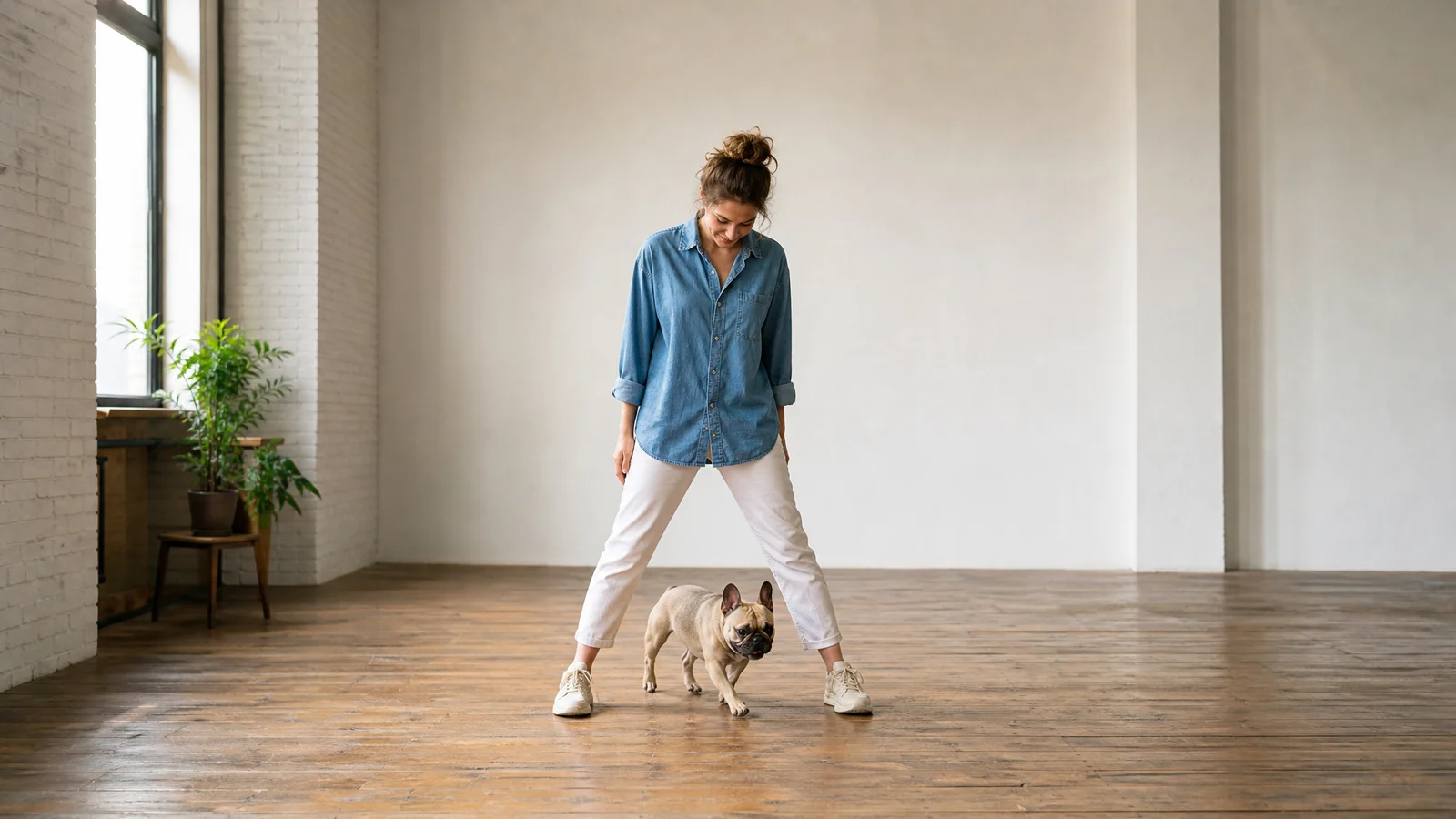
If your French Bulldog already follows a treat held in your hand, you have the one skill this trick runs on. The weave keeps that habit and stretches it over a route, so what you need most is a plan for where your hand goes and when the reward lands.
The route looks like a lot, but it breaks into short passes that each end with a reward in a spot you choose. This post sticks to the standing version, so your dog learns the shape before anything else is added.
The first win is modest and quick to reach: a single pass through the gap and out the other side, with a treat waiting at the finish. Everything else in the trick is that pass, repeated and joined.
How a French Bulldog Weave Actually Runs
That one pass has three parts, and naming them makes the trick easier to teach. Your dog walks into the gap between your standing legs, rounds one leg, and comes back out in front of you. Nothing about it needs speed or distance, so it fits a short session at home and has little in common with an agility course, which our French Bulldog sports and jobs guide covers.
Before the first treat, check that your dog is comfortable near your feet. They should take a treat beside your ankle with the gap open and be free to step away whenever they like. A dog who keeps avoiding the turn is worth a mention at a regular vet visit, and the trick can wait until you have had that conversation. Once a treat beside your ankle feels ordinary to them, you are ready to set your feet.
Where Your Feet Go for a French Bulldog Weave
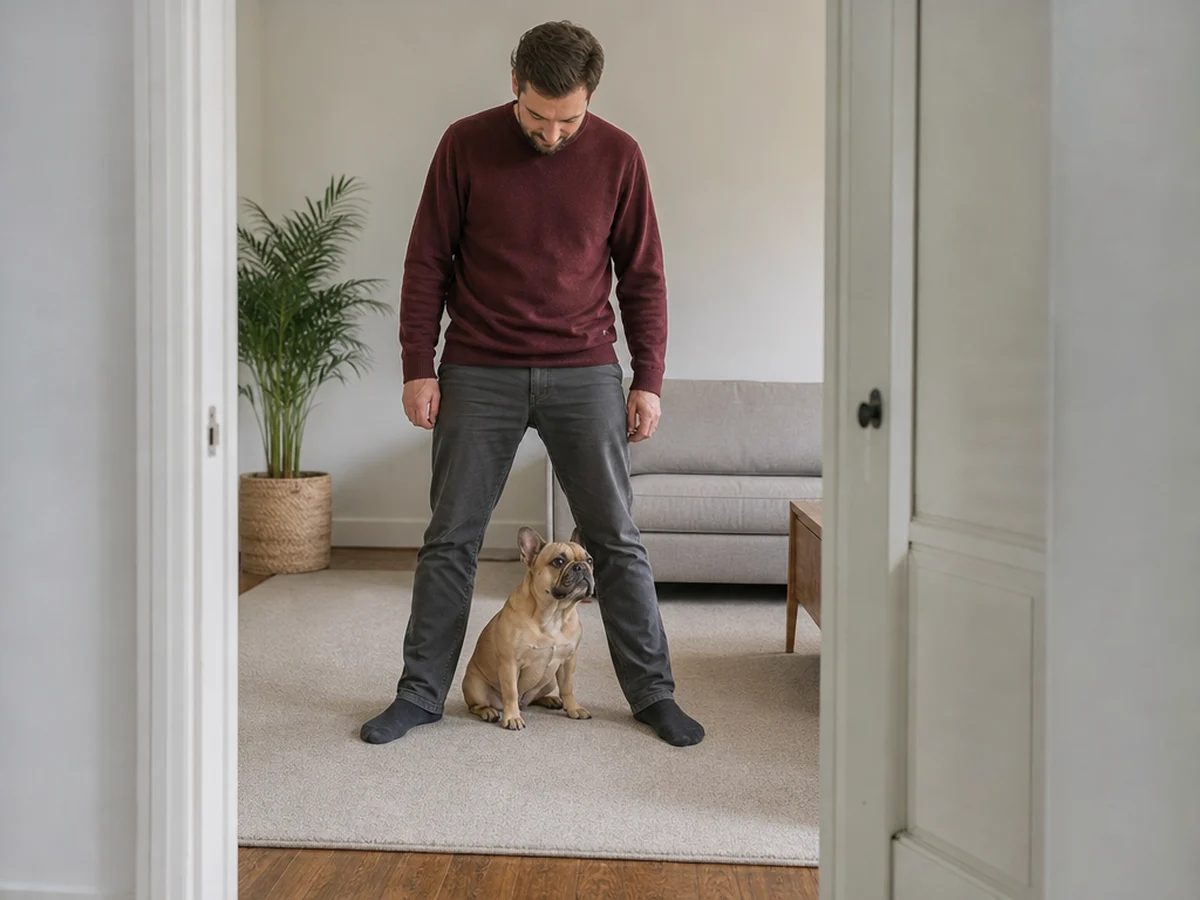
A dog at ease beside your ankles raises the next question, which is where your own feet belong. Stand still with your feet apart far enough for your dog to pass without brushing either leg, and keep the leash off so nothing can wrap around an ankle. Your feet stay planted and the hand does the work, which gives your dog the same shape to read on every pass.
The treat hand does the leading from behind one leg, so your dog is drawn through rather than pushed. Because your dog could never guess this route, we let the treat do the leading at first and trim the hand down later, and a post on the AVSAB site notes that reward-based trainers may use a combination of capturing, luring, and shaping.
The first pass is only these four moves. Nothing else is asked of your dog or of you yet, so leave out the turn around a leg until passing through the gap feels easy:
- Stand with your feet apart and your dog facing you.
- Hold the treat at your dog's nose, then sweep that hand back between your legs and out behind one leg, so your dog follows it through the gap.
- Pay as your dog arrives out behind you, not while they are still in the middle of the gap.
- Bring the treat hand back to your belt and let your dog turn to face you before you start the next pass.
Those four moves stay the same on every pass, so the treat is the only thing you adjust. If you are unsure how big the treat pieces should be, our French Bulldog complete training guide covers it.
Joining Single Passes Into a Frenchie Weave
Once single passes feel easy, a loop is only the next small step. Lead your dog through the gap and around your right leg, then bring them back to the front and pay there.
Repeat the route around your left leg with your other hand, so the treat never has to cross your body. When both sides feel steady, join them. Your dog goes through the gap, rounds one leg to the front, goes through again, rounds the other leg, and you pay only after the full figure eight.
Along the way, watch for your dog to stop chasing the smell of the treat and start following the path of your hand. That change often means the shape has registered, and it is what makes the full eight feel smooth.
Fixing Bumps and Stalls in a French Bulldog Weave
A loop that works on paper still wobbles in a living room, and the way your dog wobbles points to which step was too big. The table pairs the most common wobbles with what may be behind them and what to change.
| What you see | What may be going on | What to change |
|---|---|---|
| Stops in the middle and waits | The step may be too big, or the treat may reach them too late | Move the treat hand through sooner and pay the moment they clear the gap |
| Loops one leg and skips the other | The second side may be less practiced than the first | Go back to single passes on that side, then rejoin the two |
| Bumps or rubs along a leg | The gap may be too narrow, or your hand may pull them close to your leg | Widen your feet and hold the treat farther from your leg |
| Backs out of the gap | The gap may feel tight from the front, or the treat may not be visible yet | Show the treat at the entrance and open your stance wider |
Change one thing at a time and run a few passes before judging it, because a smaller step beats a harder push. The San Francisco SPCA's training philosophy puts a struggling student in front of a teacher, and says a good teacher would help you prepare better for the next test by improving your study methods, perhaps start you off with easier material this time, and encourage your efforts so you don't give up.
Edge Cases in the French Bulldog Weave
Everything so far has assumed one dog, you as the handler and a route that stays put. Real households stretch each of those a little, and each stretch deserves a short answer of its own.
Will my Frenchie weave for a friend?
Yes, though plan on starting over with single passes. A friend's feet, stance and hand are all new to your dog, so a route that felt easy with you can look unfamiliar. Have them run the same four moves from the list, and stay close at first so your dog has a familiar person nearby.
Can my Frenchie weave while I walk?
That is a separate lesson, and it comes after the standing version, not alongside it. Start from the same lure and the same reward spot, and ask for less movement from yourself than you expect to need.
Can two dogs learn the weave together?
Teach each dog on their own first, with the other dog out of the room or behind a gate, so neither is distracted by the other's treats. Each dog needs to learn the route without competing for your hand. Once both know it, you can ask them to weave one after the other, paying each dog before the next begins. Working side by side comes much later, if ever, and the trick never requires it.
The Cue Word for Your Frenchie Weave
A loop that holds up through those odd moments is ready for a name. Wait until the full figure eight happens every time with the treat leading, then say your word once, just before your hand starts to move. Keep paying at the finish, in front of you, so the word attaches to the whole shape and not to any single turn.
After that, trade the treat lure for an empty hand and deliver the reward from your other hand when your dog arrives. The hand now carries the route as a signal, and the word rides along with it. Our French Bulldog brain games guide shows where short sessions like this one sit in a dog's day.
A figure eight ends where it began, and by now that is true of your dog's whole route: out from you, around both legs and back to face you, with an open hand and one word to guide them. What started as a treat chasing a hand through a gap is now a route your dog can read from an open hand.
 Puppy trainingFrench Bulldog Puppy: What to Expect and How to Start Training
 Puppy trainingFrench Bulldog Puppy at 4 to 6 Months: What Changes
 Training basicsHow to Teach a French Bulldog to Heel