 Frenchie

Most of what you teach a French Bulldog puppy early on happens in minutes you barely notice, tucked between long stretches of sleep. That is good news if you are worried about finding the time, because starting is mostly a matter of knowing which small moments to use. This post walks through what the early days hold and where each early problem gets its full method.
The honest picture matters because an owner who expects lessons all day will read a sleepy, mistake-making puppy as one who is falling behind, when that puppy is doing exactly what a young puppy does. Our job is to put small rewards where they fit, and getting that expectation right makes the early weeks calmer for both of you.
French Bulldog Puppy Training Takes Little of the Day
The first fact worth planning around is how much of a puppy's day is simply rest. Lessons are the exception in a young puppy's schedule, not the frame around it, because most of the hours belong to sleep and the awake stretches are busy with ordinary puppy business.
The American Kennel Club notes that young puppies sleep a great deal of the time, and that some will sleep as much as 16-to-18 hours a day. It advises planning on quiet nap times several times during the day. For you, that means a sleeping Frenchie puppy is not a missed chance. It is the day working the way it should.
So the useful question becomes where a quiet nap can happen. Our French Bulldog crate training guide covers setting up a place the puppy will actually choose to go into, and it is worth having that spot ready before you count on any lessons. If a puppy's sleep ever looks far from what you expect, mention it at a regular vet visit and let your vet judge.
Fitting Practice Around a Frenchie Puppy's Sleep
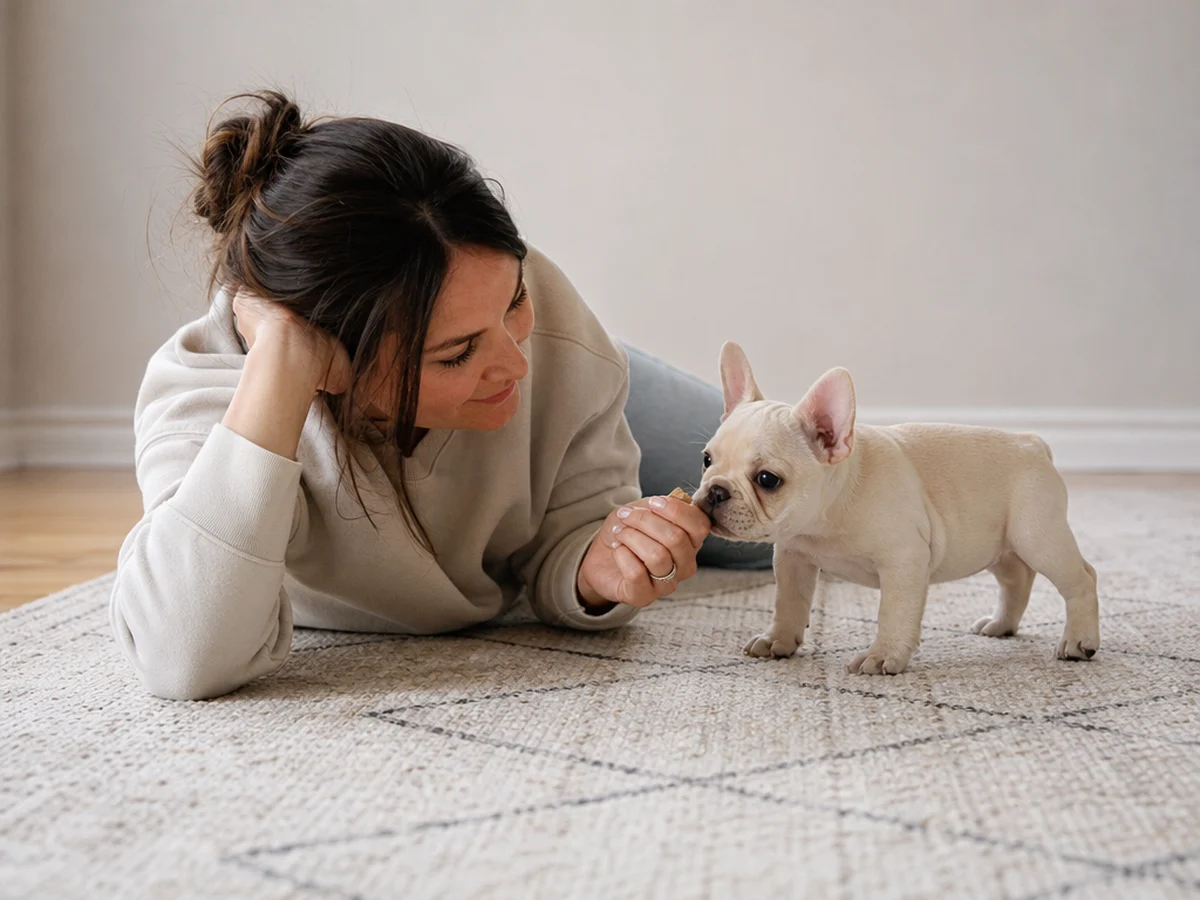
A day that is mostly sleep leaves only a few openings for practice, and how you protect the rest and how you use those openings is what the next two questions are about.
Should I wake a napping puppy for practice?
No. A lesson started on a groggy dog rarely goes anywhere, so let them wake on their own and use the first alert stretch, when they are up and looking around. Keep a few small treats in your pocket so you can reward the moment they turn toward you. A rested puppy is usually a more willing one.
What if I only have evenings for practice?
Evenings work as long as the puppy is awake and interested. They are also when many households are at their busiest, so pick the quietest awake stretch rather than the loudest one, and ask for easy things you know the puppy can do.
A reward handed over on a weekday night counts the same as one on a weekend morning. What the puppy needs is rewards that arrive soon after the thing you liked, and the clock matters far less than that.
What a New Frenchie Puppy Doesn't Know Yet
Every moment of practice happens with a puppy who is new to the house, the words and the people in it. Nothing about your home is familiar yet: which floor is for what, which sounds are ordinary, what your voice means. A puppy who gets a lot wrong in those early days is mostly a puppy who has not been shown yet.
A move to a new home rearranges everything a puppy knows, and the Oregon Humane Society says in its puppy toolkit that "Your new puppy has been through a lot of changes." A puppy still adjusting may have less attention to spare for a lesson, which is worth remembering on the days when everything seems to slip.
That is why we keep the early plan so plain. A puppy cannot be expected to understand a request in a house they have only just met, so when one is missed we show it again the same easy way and pay the moment the puppy gets it right. Nothing is lost, and the puppy learns that your hand and your voice are worth turning toward.
It also helps to know this is the ordinary state of things. PetMD says puppies "will make mistakes and may not always understand what you are asking," so a missed request is simply part of how a young dog learns.
Which French Bulldog Puppy Training Guide to Open First
Once you know how the days run and how little a puppy understands at first, the practical question is which problem goes to which guide. Each early problem has one that goes into the full method, so here is where to start for what you may meet first.
- Accidents on the floor belong with the French Bulldog potty training guide, which builds the schedule and the rewards around it.
- A puppy who is still getting used to the crate is the crate guide's territory, including how to choose the size, make the space one they want to enter and build comfort behind a closed door.
- Teeth on hands, sleeves and ankles are explained in the French Bulldog puppy biting guide, along with what to hand them instead.
- Questions about rewards, treat size and what to practice in which order are answered in the complete French Bulldog training guide.
- What changes as the months go by is laid out stage by stage in the French Bulldog puppy training timeline.
Pick the one that matches what you see most often, because each of those guides starts from the problem itself and does not assume you read this post first. None of them is a prerequisite for another, so you can come back to the others as each problem actually shows up.
What French Bulldog Puppy Training Fits Around
Whichever guide you open first, the methods inside it work on a puppy who has not yet got the hang of your home, and this post has tried to describe that puppy honestly. They sleep a great deal, they miss more requests than they catch, and they are still working out what your words and your house are for.
That is what a French Bulldog puppy's first weeks hold, and it is what any training you do in them has to fit around, whether the guide you open is about accidents, teeth or the months ahead.
 Puppy trainingFrench Bulldog Puppy at 4 to 6 Months: What Changes
 Training basicsHow to Teach a French Bulldog to Heel
 Exercise and jobsHow to Teach a French Bulldog to Roll Over