 Frenchie
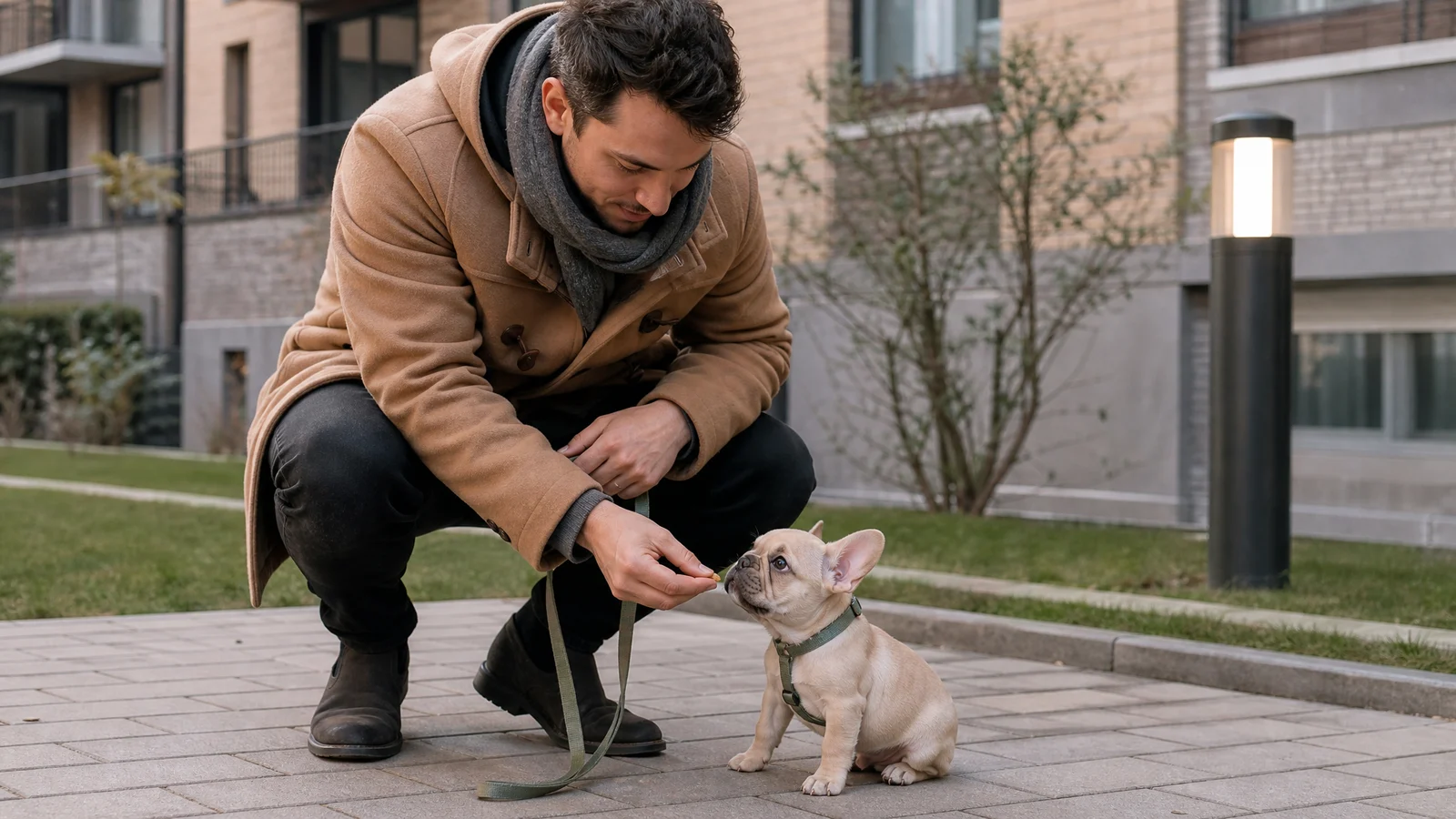
A common difficulty owners describe is waiting for the puppy to signal and then reacting once the puddle is already on the floor. Some Frenchies give no signal at all, no whining and no scratching at the door, and simply go wherever they are standing. Others go outside, do nothing, and empty their bladder on the rug minutes after coming back in.
The fix is a fixed schedule that you run, so the puppy never has to ask. A breed club board member says Frenchies are ritualistic and can be very easy to train, but you must train yourself to set a schedule and stick to it. Below, you'll find the daily timetable, crate use, trigger moments, reward timing and night trips, plus how to read accidents and a two-week starting routine.
Set a Fixed Schedule for French Bulldog Potty Trips
Start the timetable the day the puppy comes home and keep the rules identical from then on. The same board member advises against teaching one set of rules and changing it later, and says inconsistency is what makes training harder. Frenchies are creatures of habit, so whatever pattern you set in the first days becomes the pattern they expect for life.
If you need a starting grid, these are the fixed points in most households:
- The first trip of the day, before breakfast, with the morning brushing ritual right after it so the two become linked.
- A trip after every meal and after every nap.
- A trip after play, excited greetings and zoomies.
- The last trip before bed.
- A timer trip in between, whether or not the puppy asks.
The timer trip is the one owners lean on most. Many found that going out very often and stretching the gap gradually beat waiting for a request that never came. If your Frenchie goes out, does nothing, then pees inside soon after, count the trip as unfinished. Keep them on a leash beside you or in the crate, then go back out.
Expect a wide spread in results. Many puppies fall into a routine after about 4–6 weeks, but true reliability usually arrives around six months, when they have better physical control. Owners report anything from about 3–4 months to 2 years, and several who raised other breeds say their Frenchie took far longer. Some slow learners have months of accidents and then stop almost overnight.
The Crate Supports the Potty Routine
Pick a crate tall enough for the puppy to rise in and long enough to stretch out, with room to pivot and nothing more. If it is much bigger, one end becomes a bathroom and the crate stops helping. The breed club says a crate-trained puppy is easier to housebreak, because a dog regards their crate as a den, a safe haven and home.
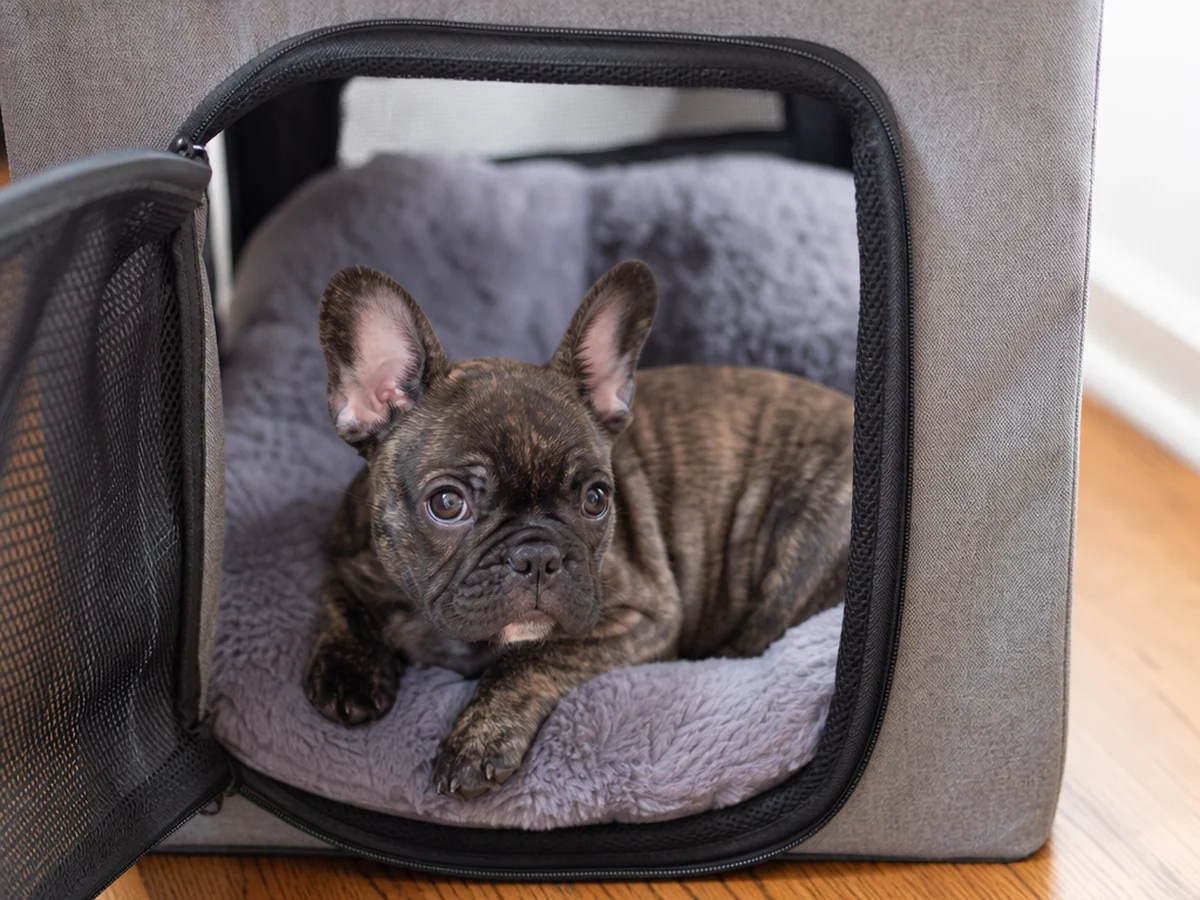
Run the crate as a loop: crate, straight out to the potty spot, reward, supervised freedom, then back in whenever you cannot watch. If the puppy soils the crate soon after an outing, check three things in order. Were they in there longer than they could manage? Is the space too large? If neither fits, treat it as a possible medical issue and call your vet.
Some Frenchies pee or poop on beds and blankets and then lie in it. If yours does, switch to washable bedding and strip out the soft layers while the routine settles. Keep the crate pleasant with a chew toy and treats dropped inside, and never send the puppy there as a punishment. Teething makes chews useful, and our guide to French Bulldog teething and puppy biting covers what to offer.
In warm areas, put cooling pads and fresh water in the crate. A relaxed crate habit also pays off later, since a Frenchie who is content in a crate copes much better if illness or injury ever calls for enforced quiet.
A French Bulldog Puppy Gets a Potty Trip After Every Nap
A young puppy has a small bladder and little control, so frequency matters more than patience. Owners who succeeded timed trips to the puppy's own triggers, not to the clock alone. Take them out at each of these moments:
- Straight after waking, even from a short nap.
- Soon after eating or drinking.
- After play, and the moment zoomies wind down.
- Before you let them into any room where they have gone before.
- When you see sniffing, circling or sudden wandering off.
If accidents cluster after one trigger, move that trip earlier. A puppy who has an accident shortly after every meal needs the post-meal trip sooner, not a lecture. A simple log of meals, naps, drinks and trips makes these clusters obvious within a week, and it also shows whether the empty-trip-then-puddle pattern is happening.
Carry a very young puppy to the door. A small puppy often cannot make it alone, and a carried puppy cannot have an accident on the way. As control grows, let them walk and stretch the gaps slowly. If you stretch too fast, accidents will tell you, and the fix is to go back to the last interval that worked.
Rooms matter too. A puppy who goes in the same room again and again is telling you that room needs a trip first, a gate across the door, or both.
Reward the Potty Within Seconds
Timing decides whether the treat means anything. If the puppy finishes and you wait until the walk back to the door, they have learned nothing about the yard. Reward immediately once the puppy has finished, so carry the treats in your pocket and deliver at the spot.
One Spot, One Cue, One Treat
Walk the puppy to the same patch on a leash, stand still and stay quiet. Say a short cue such as go potty once as they begin to go, and have everyone use the same words. Several owners say their dog now goes on cue, which helps a great deal in rain and cold. Save play for after the reward so the trip stays about business.
Many Frenchie owners credit food over praise, often a better treat kept only for outdoor potty. Others rewarded every success and still had indoor accidents for months. If that is you, the reward is rarely the problem. Look at supervision gaps, trips spaced too far apart, and what happens in the minutes after you come back inside.
Weather and Surface Quirks
Flat-faced dogs handle heat poorly, so keep potty breaks brief during the heat of the day and save longer walks for early morning or evening. In cold weather, supervise as well, because shivering means too much exposure. Some Frenchies refuse wet grass, go indoors when it rains, or stay attached to one surface. If yours does, offer a dry or sheltered patch and lean on the cue word.
Potty Accidents Are Information, Not Defiance
Every accident tells you which part of the schedule failed, so read it before you react. When you spot the puppy in the middle of an accident, calmly interrupt, carry them out and reward them if they finish there. If the mess turns up later, clean it with an enzyme cleaner and say nothing. A scolding can teach a puppy to go out of sight, and out of sight is already a common complaint.
Because many Frenchies give no obvious signal, learn the quiet ones. Owners who cracked their dog's code describe these:
- Sitting by the back door, or running around and then bolting to it.
- Sniffing the floor and circling.
- Intense face licking directed at you.
- Yelping and leading you to the door.
If accidents land on a couch, pillows, shoes or a closed door, check what happened just before. Many owners link these to being left or to play ending. Read that as stress or a gap in the plan, not spite. Shorten the time alone and widen freedom one room at a time. Some dogs only slip up when people are home, others only when alone, so the pattern in your own house is the useful evidence.
Around 6–8 months, hormones can bring accidents or marking even in a trained dog. Treat it as a stage, and see our guide to the teenage phase for how it plays out. If a reliably trained older Frenchie starts having accidents, that is a vet question first and a retraining job second.
This is general information, not veterinary advice. Sudden accidents, straining or constant urgency can be a health problem that looks like a training problem, so check with your veterinarian and keep up regular vet visits.
Night Potty Breaks Shrink Gradually
Night trips belong to the same schedule, in a deliberately dull version. Keep the lights low, skip play, reward success at the spot and go straight back to the crate. After a night trip with no play, if the puppy has had ample chance to go, a little whining usually fades and they settle.
Night breaks lengthen as the puppy matures, not on a date you choose. When your puppy starts waking later or settling without fuss, push the last trip of the evening a little later and let the middle-of-the-night trip drift later too, one small step at a time. Ask your veterinarian what is reasonable for sleeping through the night at your puppy's age.
If accidents happen only overnight, work backward. Was the last drink or meal too close to bedtime? Was the final trip a real one, or a quick glance at the grass? Owners also report night-only accidents when a puppy is anxious about being apart from their people, so check where the crate sits.
Setbacks are normal. Owners describe regression after a move, a surgery, a holiday tree or a change in routine. Drop back to the last stage that worked, then rebuild.
Your French Bulldog's Potty Plan for the Next Two Weeks
You can start tomorrow. The plan leans on the breed's love of ritual, so the goal is a day that looks the same from one morning to the next.
- Day one: choose the potty spot and cue, set meal and crate times, buy an enzyme cleaner and get everyone in the house using the same words.
- Days two and three: run the timer trips plus every trigger trip, reward at the spot, and keep the puppy in sight or in the crate whenever you cannot watch.
- Rest of week one: log every accident, find the cluster, move that trip earlier and let the morning brush follow the first trip.
- Start of week two: stretch the gaps between timer trips slightly, but only after a stretch without accidents.
- Middle of week two: open up one more gated area, and step back a stage if an accident returns.
- End of week two: review the log, trim a night trip if the puppy is settling, and book a vet visit if accidents persist.
For the longer picture, our French Bulldog puppy training timeline shows how owner experiences stretch across the first two years. Whatever pace your Frenchie sets, the lesson holds for this ritual-loving breed: you set the routine, run it every day, and the puppy learns to follow it long before they learn to ask.
 Training basicsHow to Train a French Bulldog: The Complete Guide
 Training basicsHarness and Leash Training a French Bulldog
 HealthFrench Bulldog Heat Stroke: Signs, Prevention and Hot Walks