 Frenchie
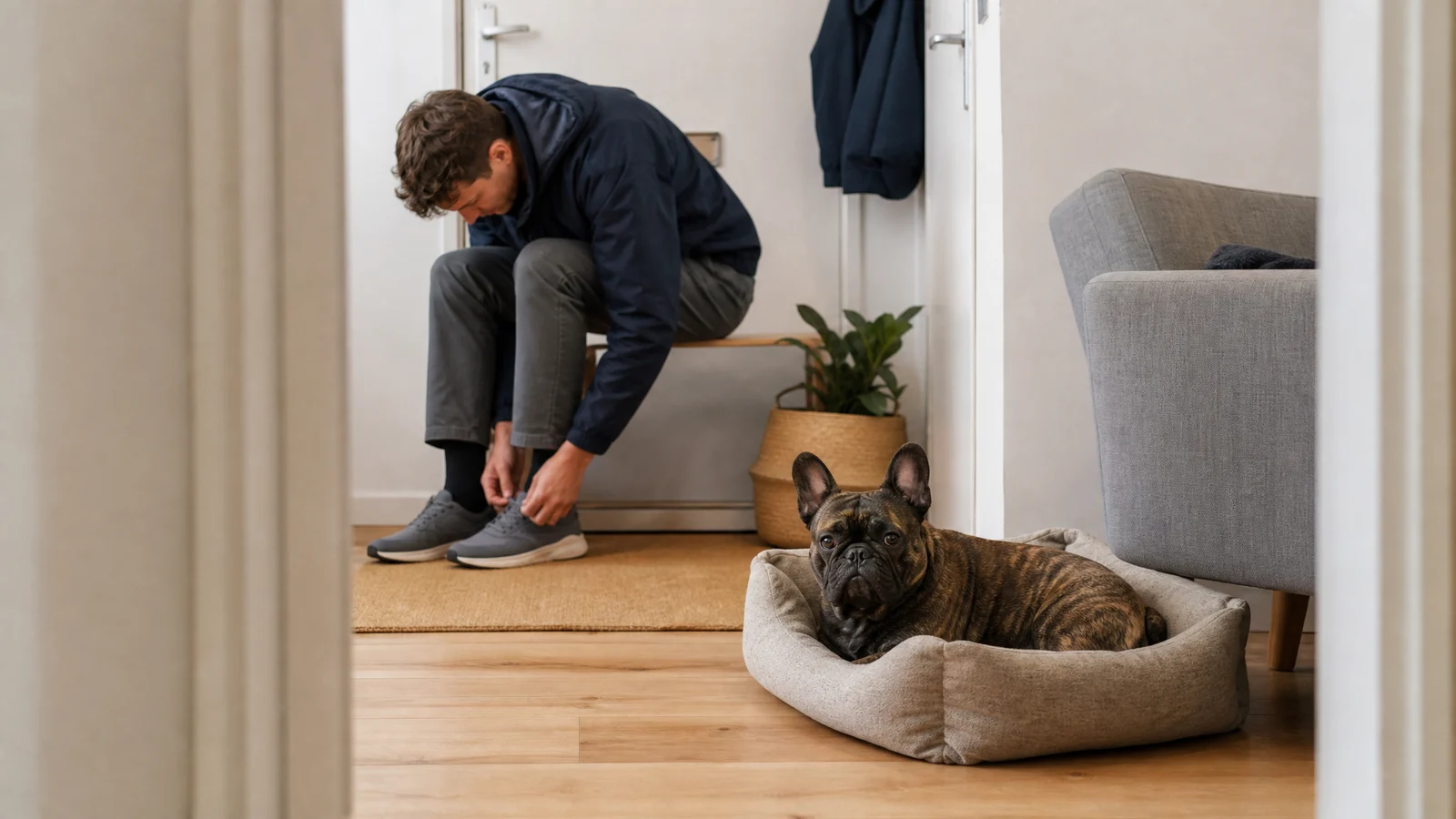
Ordinary puppy advice says to let a puppy cry it out and stretch solo time as fast as possible. A French Bulldog can't be left outside, overheats easily and does best with short absences, so the plan changes from day one.
This matters because the breed was created as a companion, and they do not do well left alone for extended periods. Handle it well and you get a small, quiet apartment dog who settles happily. Handle it badly and you get a puppy who cries, neighbors who notice and habits that are hard to undo.
In this article, we'll go through one worked example, a puppy in a two-bedroom apartment, covering house rules, the indoor setup, short absences, early clinginess and keeping neighbors comfortable. We have trained this breed for many years, and the example reflects patterns we see again and again.
A Ten-Week French Bulldog Puppy in Two Bedrooms
To see how the pieces fit, we'll follow a typical household through the first months. Our puppy is a French Bulldog, ten weeks old, settling into a two-bedroom apartment for the first time.
Two terms first. Alone time means any stretch when the puppy can't see or reach a person, including when you are in the next room. Management means arranging the home so mistakes can't happen, and with this breed it is part of the training plan.
Puppy-proof the way you would for a toddler. Frenchies are curious and naive, and if there's trouble in the room, their curiosity finds it the moment you turn your back. Cords go up, small objects go away, and the puppy gets daily activities, or they will invent their own.
Here is the layout we'll use for the rest of the article.
| Space | Role in the example |
|---|---|
| Living room | Main hangout, with a pen and crate along one wall and a patch of cool, hard floor |
| Bedroom one | The adults' room, where the puppy sleeps at night in a crate beside the bed |
| Bedroom two | Home office that shares a wall with the neighbors |
| Entry hallway | The door to the shared corridor, where sound travels |
| Balcony | Not part of the plan, since this is an indoor dog |
The adults split the week. One works away from home on some days, with a midday visit or a dog walker, and the other works from home on the rest. There is no yard, and that is fine. French Bulldogs do well in small spaces and are not noisy, which is why they suit city life.
Day-One House Rules for Apartment Behavior
House rules decide where the puppy sleeps, which furniture they can use and where alone time happens. Make them before the puppy arrives. This is a routine-loving breed, and the rules learned as a puppy tend to stay, so teach the adult version from the start.

Setting house rules from day one works because a bad habit is hard to break. If the sofa is off limits, for example, play on the floor so the puppy learns that fun happens down there. Our example household settles on these rules:
- Night sleep happens in a crate in bedroom one. A puppy let into the bed for a few cute weeks will expect it as an adult, so allow it only if you want it for life.
- The sofa is allowed only with a step or ramp beside it, because leaping down is a back risk for this breed.
- Alone time always happens indoors, in the pen or crate. The balcony and the hallway are never options, since a French Bulldog can't be left outside, especially in warm weather.
- Meals, walks and departures follow a set schedule, because their love of ritual makes them easy to train when the adults stay consistent.
- Every adult applies each rule the same way, every day.
Some advice says to relax the rules while the puppy is tiny and tighten them later. With a Frenchie that is backwards. Given the chance, they take charge of your activities and your bed, and changing the rules afterward is the hard part.
Indoor Spaces That Keep a French Bulldog Safe Alone
Safety indoors has three parts: a place to rest, a temperature you control and something safe to chew. Our example sets up all three in the living room, away from the entry hallway.
The pen holds a crate with its door propped open, a bed and a water bowl that can't tip. Many owners find the crate is where their Frenchie settles alone, often covered, with a blanket, a toy or the radio. A few find the opposite, that the crate made things worse and a pen became the dog's own space. Offer both and watch which one the puppy chooses.
Keep a covered crate dark and quiet. Daytime is often harder than night, since puppies who settle in a crate overnight can still cry when crated by day.
Temperature is the non-negotiable part. Always keep a French Bulldog inside a cooled home during the heat of the day, and leave cool floor space near the pen. Consider a temperature alarm that alerts your phone, because dogs may be in danger if air conditioning or power fails unnoticed.
For alone-time chews, choose durable ones that don't soften into lumps. Powerful bulldog jaws destroy flimsy toys, and softened rawhide can lodge in a Frenchie's throat, so skip rawhide. Save the best chew for departures, so that leaving becomes the moment it appears.
Building Calm Alone-Time Behavior Through Short Absences
Think of alone time as a savings account. Small, regular deposits of calm build a balance, while one big early withdrawal empties it. Our example puppy begins with absences of only minutes, and the length grows only after a calm one.
That is the opposite of the cry-it-out approach. Many owners report that a Frenchie can cry, whine, howl or scream once you leave, from young puppies to adults, so the plan keeps each absence short enough for the puppy to stay calm. The first weeks look like this:
- Tire the puppy gently with a walk or play, then settle them in the pen with a chew. A set routine before leaving becomes a cue that calm comes next.
- Practice pretend departures: pick up your keys, step out and return during a quiet pause rather than during crying. A treat as you leave helps.
- Lengthen the absence only after a calm one, and drop back a step after a hard one.
- Keep leaving and returning low key, with no big goodbyes.
- Add a camera. Several owners only learned how their Frenchie coped from footage, finding that a dog calm on their return had cried for much of the time they were gone.
Watch the early window. Separation-related behavior stems from time spent apart from you, and signs can show up either before you head out or after you have gone, usually starting within a few to 30 minutes. If the puppy is truly distressed, treating separation anxiety means not leaving them alone beyond training sessions. Use lunch visits, a walker or the other adult to cover the gaps meanwhile.
The breed club cautions that Frenchies do not do well alone for extended periods, so the goal is never a full workday of solitude. Owners report a wide spread, from an hour or two to a full day, usually broken up by a visit or walker. Progress ranges from quick to a year, and a few say it hasn't worked yet.
When Clingy Behavior Shows Up in Week Three
By week three, our example puppy has become a shadow. They follow the adults to the kitchen, sit on feet and want a lap. Before calling it a problem, separate two things: attachment and distress.
Attachment is the wish to be near you. Many owners describe velcro Frenchies who sit on them or walk under their feet all day, from 13 weeks to old age. That fits a breed created as a companion, one that loves being the center of attention.
Dogs Who Are Not Velcro
Not every Frenchie is like this. A sizeable minority of owners describe independent dogs who stay nearby but avoid laps and cuddles, and others are clingy only by mood or in winter. Owners with two or three Frenchies sometimes see both styles under one roof. All of this is normal variation.
Distress is different. It shows as crying, whining, howling, screaming or barking, and sometimes as quieter signs such as pooping every time you leave or peeing on the bed. A simple test: can the puppy settle with a chew while you are in view, or in the next room? A clingy dog who can settle is simply attached.
Practice daily by rewarding the puppy for resting on their own bed while you are present, then from behind a gate. Owners also link new distress to a change, such as a move, a new midday walker or being left somewhere other than home, so look for the change first. For more on how these habits develop, see common French Bulldog behavior problems. Neediness often eases with age and practice, though not always fully.
Neighbor-Friendly Behavior From a French Bulldog Puppy
Our example's pen is in the living room, but sound still travels through the entry hallway and the wall that bedroom two shares with the neighbors. Frenchies are not known as noisy dogs, yet young puppies cry, and daytime crying carries when a building is quiet.
Owners describe crying, whining, howling and screaming more than steady barking. Our guide to French Bulldog barking and screaming covers the differences. Some puppies sound dramatic when crated yet go quiet or sleep once a camera shows what happens next. These steps keep everyone at ease:
- Tell the neighbors in the adjoining units before the puppy arrives, explain that a young puppy is learning to be alone and share how to reach you.
- Keep the pen away from shared walls and the front door, so hallway sounds such as the walker's arrival don't set off crying.
- Use sound cover. Several owners found that TV, cartoons, music, the radio or a low window kept their Frenchie calm, and several later stopped needing it.
- Exercise and settle the puppy before leaving, since a rested puppy is a quieter one.
- Use a camera to learn when the noise happens, then shape training around those moments.
Don't solve noise by sealing the apartment. The home must stay cool and aired, so rely on pen placement and sound cover rather than shut windows. If a neighbor does mention noise, treat it as useful information about your schedule.
French Bulldog Alone-Time Behavior at Six Months and Beyond
At six months, our example puppy is bigger but still learning. What to expect from here is a dog whose alone-time skills hold as long as you keep using them. Some Frenchies are calm alone, sleeping, playing or waiting by the door. Others cry from puppyhood into adulthood, and a few trash the house after a routine change.
Older Frenchies often still want you in view, follow you in and out of rooms, or stay clingy even when you are home all day. That is the companion they were created to be. Plan for it rather than training against it, and keep a regular vet visit on the calendar, mentioning any sudden change in appetite, accidents or mood.
A second dog eases or ends the crying for some households, while other owners say it helps but doesn't remove the stress. Losing a companion dog can bring grief. Most owners who lost one describe a Frenchie who moped, ate less or searched the house for weeks to months. Extra attention and company helped.
The lasting picture is simple. A French Bulldog stays a companion who needs short, planned absences and an indoor, cool home. The day-one rules you set for the example puppy, a sleeping spot, furniture access, a routine and no time outside, are what make that easy for years.
 Puppy trainingFrench Bulldog Puppy Biting: Teething, Nipping and When It Eases
 Puppy trainingFrench Bulldog Puppy Training Timeline: 8 Weeks to 2 Years
 Exercise and jobsHow Much Exercise Does a French Bulldog Need? Plus Brain Games