 Frenchie
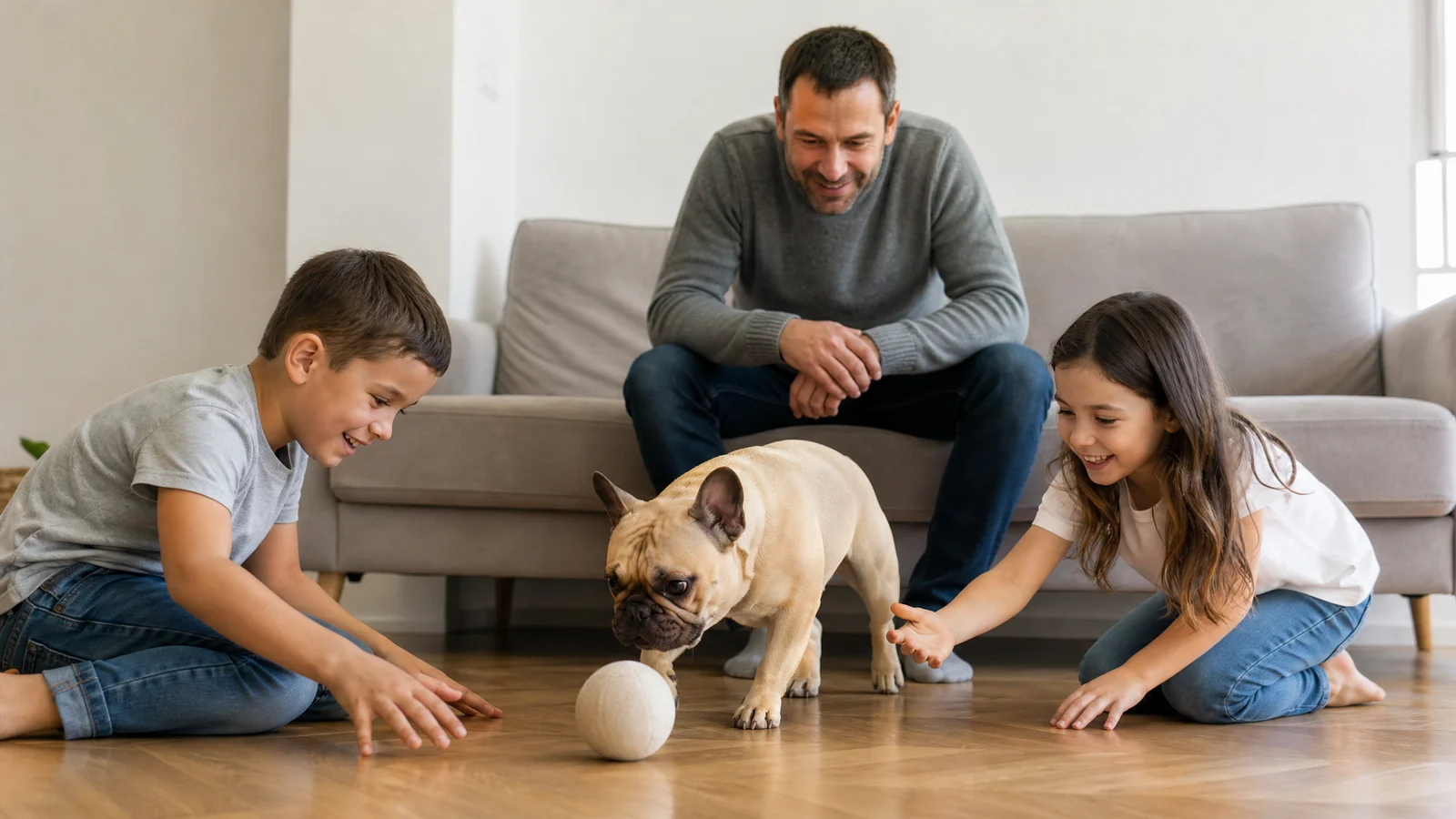
Plenty of French Bulldogs do well in homes with children, and the American Kennel Club describes the breed's affectionate, laid-back nature as a good option for families. It adds that French Bulldogs are good around young children due to their size and lack of aggression.
This guide stays with the ordinary moments where a Frenchie and a child meet, from floor games to a baby on the way. How those moments go depends on what happens at the dog's level and on whether an adult is in the room, which is why most of this page is about arranging the home rather than judging the dog. A Frenchie who gets a calm, predictable day with children is easier to live with, and so are the children.
Floor Games Kids and a French Bulldog Can Share
The American Veterinary Medical Association says to always supervise young children when around dogs, no matter how well behaved either are. It also says to avoid highly excitable games like wrestling or tug-of-war, which can increase the risk of a nip or a bite.
Calm games give a Frenchie something to do with a child that is not a scuffle. A child can roll a few treats across the rug for the dog to find, or hide one under a plastic cup and let the dog nose it out. The dog is rewarded for working with their nose instead of their mouth, and the adult stays within reach.
A trade game suits a dog who gets worked up over a toy. The adult offers a treat, the dog lets go of the toy, and the toy comes back after a short pause. A child can watch this for a while before taking a turn at handing over the treat.
Breaks and Warm Days
When voices rise or the game gets rough, an adult calls a break. The dog goes to a mat or a chew in another room and the children switch to something quiet. Making breaks routine instead of a reaction means the dog is rewarded for settling, rather than scolded for being excited.
End each round while the dog is still keen, and stop sooner when they seem tired or hot. Warm days call for shorter, cooler, indoor play, and our French Bulldog heat guide covers what to watch for. A puppy who mouths small hands needs more than game rules, so our French Bulldog puppy biting guide lays out the plan for that.
Short Answers About Kids and Your Frenchie
Households settle a lot of small things before anyone thinks to write them down, such as who walks the dog, who hands out treats and where the dog sleeps. Settling them ahead of time spares the dog from being the one who finds out where the limits are.
Can a child walk the Frenchie?
A child can walk beside an adult who holds the leash. The child's job is handing out treats when the dog walks nicely at their side, which keeps the walk fun for both of them without giving the child control of the dog.
What if a child is afraid of the dog?
Let the dog rest on a mat across the room while an adult drops treats for staying put, and let the child look on from the doorway or the couch, whichever feels easier. Nobody forces a touch, and the child decides when to move closer, and a dog who has learned that the child's presence means treats makes that step easier.
How does a child get space from the dog?
Put a bed or mat in the room where the child spends time and reward the dog for settling on it, so staying nearby no longer means being underfoot. When the child wants space, a gate or a door decides it, calmly, with a chew waiting on the dog's side.
Can the kids give the dog treats?
Yes, with an adult close by. Show the child how to hold a treat on a flat hand and wait, and give it only when the dog is sitting. A dog who is jumping or grabbing gets no treat until they sit, and our French Bulldog greetings guide works through excited jumping at the door.
Should a Frenchie sleep in a child's bedroom?
Make it the dog's choice, never a place a child can trap them in. Leave the door open or use a gate instead of closing the two in together, and keep the dog's bed where they usually settle so they can leave whenever they want.
What if the dog ignores a child's cues?
Expect that at first, because dogs learn whom to listen to by what pays off. Let the child use the same short word the adults use, and have an adult reward the dog the moment they respond. The adult stays the one who backs up the cue until the dog answers the child reliably.
Meals, Chews and Naps Are Off Limits to Kids
Blue Cross advises that, for visiting children, a child should never approach or disturb a dog who is eating, has a toy, has puppies, is sleeping, is in bed or under a chair or table, is sick or injured, or is trying to move away. It also advises teaching children to give dogs space and let the dog choose whether they want to interact.
For a Frenchie in a busy house, that turns into a few decisions about placement. Feed meals in a corner or room that passing children do not cross, and let an adult hand out chews so a chew is never something a child can stumble into. Put the dog's bed somewhere calm and away from the main routes, with a second resting spot far from the children's play corner.
At feeding time, a gate or a closed door does the job when children are running through. When everyone has finished, the dog comes out to a quiet room instead of a crowd, and the first greeting they get is a calm one from an adult.
Real Jobs Kids Can Do for Their French Bulldog
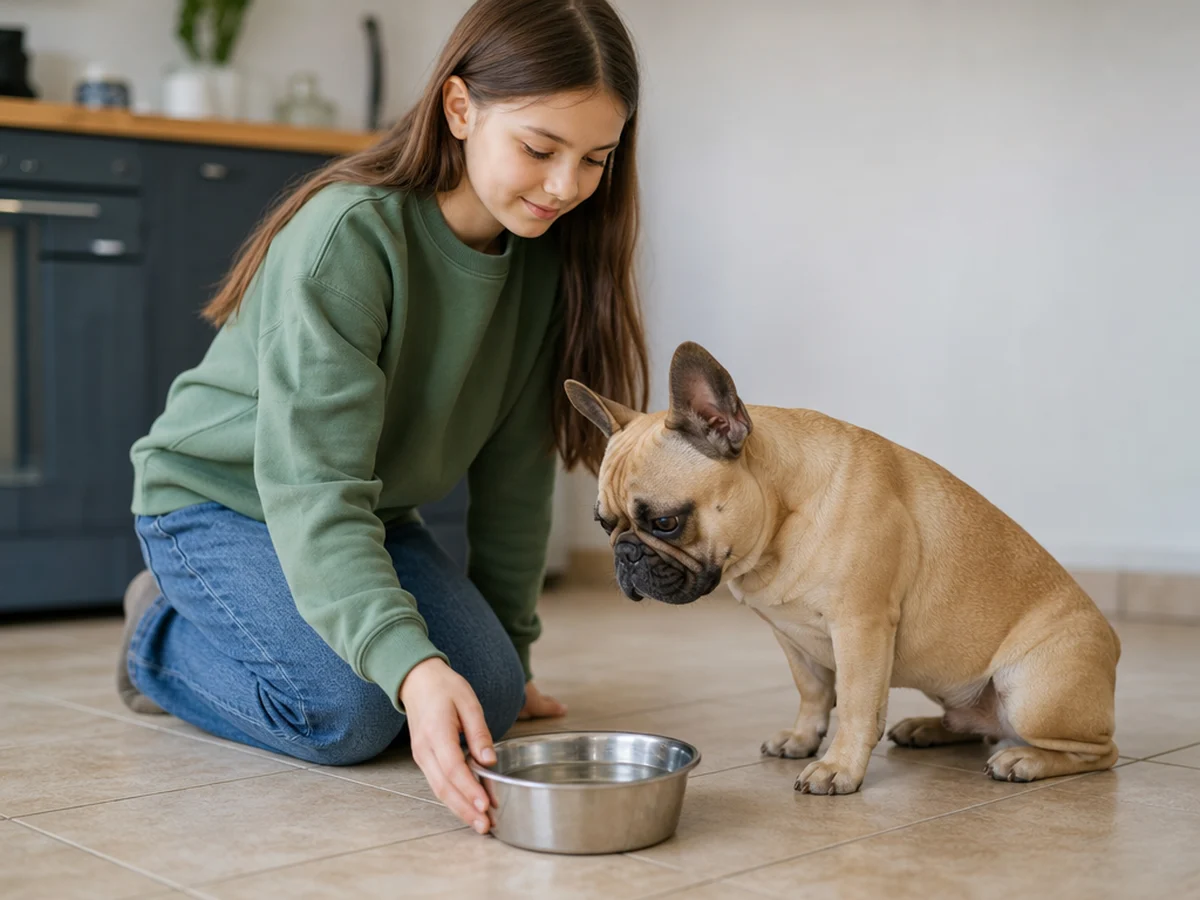
Children get more out of a dog when they have real jobs that make the dog's day better, and a Frenchie gets more out of children who do those jobs the same way each time. Choose jobs by what the child can manage safely, not by a fixed age, and keep an adult nearby for all of them.
Topping up the water bowl and carrying the dog's food scoop to the counter are easy first jobs. A child can also pick which of three toys comes out for the day and put the others away, which makes toys something the family manages instead of something the dog and a child compete over.
A slightly bigger job is the treat routine. The child sits on the floor, the dog goes to their mat, and the child drops a treat onto the mat every time the dog stays there, while an adult watches the timing. The dog learns that a quiet child on the floor is a good thing, and the child learns that the dog's calm is something they helped make.
Keep the child's part small and certain, and leave anything that needs the dog to hold still for hands, like grooming or nail trims, with adults. When a job goes wrong, the adult takes it over without fuss and the child tries again later.
Laps, Cuddles and Carrying a French Bulldog
Cuddling works best when the dog starts it. Seat the child on the floor or at one end of the couch and let the dog walk over and pick a spot. A dog who arrives on their own and settles is saying yes, and a dog who gets up and leaves is saying enough. Nobody follows.
A child who wants a cuddle can ask and then wait. If the dog comes over, the cuddle is on. If they do not, the child has a turn at something else, like tossing a soft toy, and nothing is lost. Waiting to be invited is a skill children can learn, and a dog who is never grabbed keeps choosing to come back.
Lifting and Carrying
Picking the dog up is a job for adults only. A wriggling dog in a child's arms can slip or be dropped, which hurts the dog and frightens the child, so a child who wants to help carries nothing and walks beside an adult instead. Regular vet visits matter for any dog in a busy house, and the vet is the right person to ask how your Frenchie handles being touched and picked up.
Babies, Toddlers and Your French Bulldog
VCA Animal Hospitals says that once the baby arrives, owners should progress gradually, avoid any situations that might lead to fear, anxiety or discomfort in the baby's presence and make all associations and experiences in the baby's presence positive. It also says every effort should be made to allow the pet into the room for food, play or affection when the baby is present.
In practice, the dog's best things happen while the baby is around: a chew while the baby feeds, a treat for settling nearby, a calm word from an adult who is not busy. A Frenchie who learns that the baby predicts good things has a reason to relax instead of a reason to worry.
Crawlers and Toddlers
ASPCA advises, for dogs living with a baby, that a dog who learns they can simply walk away when the baby makes them nervous will never feel trapped in a stressful situation. For toddlers, it says never to force your dog to interact with your toddler and to let the dog approach on their own.
Our own way to give a dog who needs it that exit is a mat. Ask the dog to go to the mat, reward every trip, and the mat becomes an easy place to be when a crawler heads their way. An adult stays near the mat so the child never reaches the dog there.
As the child moves from lying to crawling to walking, the gates and play areas move too. First the baby's mat gets a barrier around it, and later the dog's rest area gets one, so the dog always has somewhere the child cannot follow. Set up each new arrangement before it is needed, so the dog already knows the mat and the gate when the child starts to move.
Supervising Children Around Your French Bulldog
Dogs Trust reports that up to 91% of dog bites to children happen at home with a known dog. Its advice is to stay close and pay attention, step in as soon as you notice a problem, and separate if you are busy or distracted, using baby gates, play pens, highchairs or even different rooms.
- A baby gate across a doorway works when you are in the next room and want the two to see each other without sharing space.
- A closed door is for the loud stretch of the day, when children are racing around and the dog needs a quiet room.
- A bed with a long-lasting chew gives the dog a rest between play sessions while the children carry on.
- A leash looped over an adult's wrist keeps a young or excitable Frenchie close without anyone holding on, for short moments only.
Supervision also means reading the dog, and older children forget themselves when a game gets loud, so they need a nearby adult too. A stiff body, a growl or a dog who keeps leaving the room is asking for space, and our French Bulldog growling guide explains what those signals mean. Building comfort with children takes time and good experiences, and our French Bulldog socializing guide covers how.
Reward the calm moments too. Drop a treat to the dog when a child sits near and the dog stays relaxed, and praise the child for gentle touching, so both of them learn the same lesson: quiet company pays off.
 Training basicsHow to Teach a French Bulldog to Sit
 Training basicsHow to Teach a French Bulldog to Lie Down
 BehaviorTraining an Older or Adopted French Bulldog