 Frenchie

No, French Bulldogs are not naturally aggressive, but a Frenchie can growl, guard or snap when they are afraid, in pain or crowded. The breed standard asks for an even disposition, and the breed's parent club adds that reaching it takes good genetics plus socialization and training from you.
That gap between the written temperament and the dog on your sofa is where trouble starts. Owners describe growls, puffs, squeals and a high-pitched trill that rarely become bites, yet a complaint that gets brushed aside can climb toward something louder. A companion breed made to stay close to their person will protest when that closeness feels threatened. Heard early, a growl gives you a small problem to solve.
Below, you'll find what the standards expect, then household case files, including a small apartment, a home with young children and a two-dog house, and finally the one kind of growl that belongs with your vet before any training begins.
French Bulldog Aggression and What the Standard Expects
The US standard describes "well behaved, adaptable and comfortable companions with an affectionate nature and even disposition," generally active, alert and playful, but not unduly boisterous. Nothing in that wording describes a guard or a fighter. Playful without being pushy is the target every training plan for this breed aims at.
The international standard, used outside the US, words it a little differently. It calls the Frenchie a sociable, lively, playful, possessive and keen companion dog, and it lists an aggressive or overly shy dog as a disqualifying fault. Possessive is the telling word. Some Frenchies may not want to share their person with other dogs, which is why the two-dog section below matters.
We reviewed 1,329 French Bulldog owners' first-hand accounts, and the dominant picture is noise without follow-through. Many dogs grumble, puff and trill, and several owners say their Frenchie has never bitten in anger. They describe play nips that sink no teeth, a finger in the mouth turned into licking, and a dog who lets you take things out of their mouth.
Exceptions exist. A health survey of the breed recorded temperament problems in some of the dogs it covered, so nobody can honestly promise an always-easy Frenchie. Owners also place the start of trouble anywhere from early puppyhood to young adulthood, and a couple call it a phase.
A popular line says Frenchies are too friendly to worry about, so every grumble is theater. We would not file it that way. Each growl tells you what that particular dog finds too much, and the case files below are practice in reading it.
Guarding Aggression in a French Bulldog Apartment
Frenchies generally do well in small living quarters and are not noisy, which is much of why they suit city life. They are also alert, and in an apartment every footstep in the hall, the elevator chime and the doorbell arrive within a few feet of the dog's bed. Some answer with a bark. Others go still on the sofa and let out a low rumble, as though thinking it over.
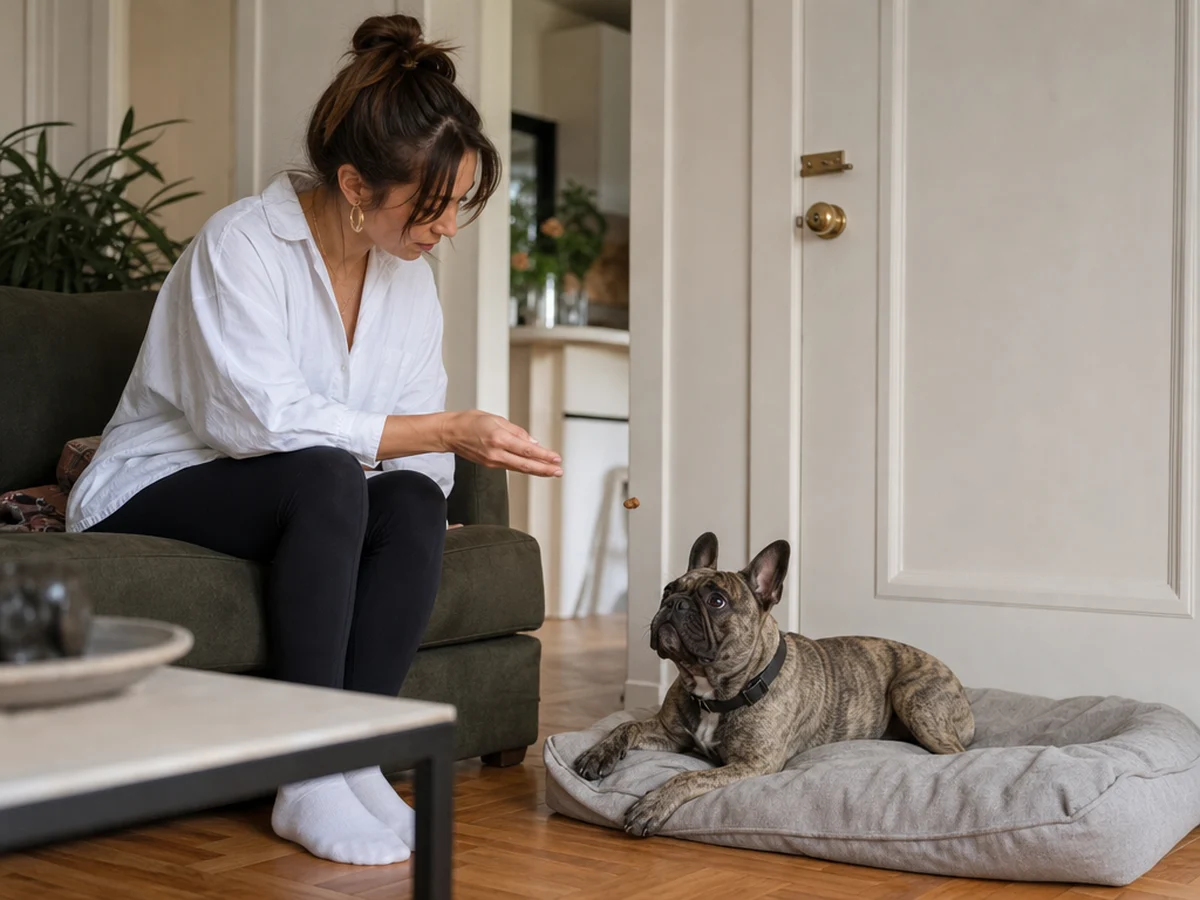
The breed can be a little territorial, but that is where the job ends, and a Frenchie is no guard dog. What looks like guarding in an apartment is often a worried dog with nowhere to go. As the ASPCA explains, a fearful dog normally retreats but may become aggressive if cornered or trapped. A Frenchie wedged into a sofa corner while a visitor reaches over has little left to say except a growl.
Owners who report guarding describe resting spots as much as the food bowl, with growling when a dog is lifted off a bed as a common example. In a small home the bed and the sofa share a few square feet. Some adopted dogs begin guarding a person or a room only after they have settled in, so a quiet first few weeks proves nothing.
Work the apartment in this order:
- Watch the second before the growl: a stare toward the door, a stiff body, a quick glance at you. Reward calm right there, not after the noise.
- Pair the doorbell and the knock with treats tossed onto a mat well away from the door, so the sound predicts food and a settled spot.
- Give the dog a bed or crate in a corner visitors do not walk past, and let them choose to go there.
- Ask guests to ignore the dog and let the Frenchie make the approach.
- Call the dog off the sofa and reward them for coming, rather than lifting them away.
If barking is the bigger worry than growling, our piece on barking, crying and screaming goes deeper.
Young Children and a Touchy French Bulldog
On children, the honest answer is a conditional yes. Frenchies do well with kids given early socialization, and both the child and the dog must be taught respect and care, with rules set for each. Skip the second half and the first stops being true.
A Frenchie who adores a lap may object to being lifted off it, hugged half asleep or loomed over while chewing. Owners name handling and pain as the triggers behind the rare defensive snap, and their list includes nail clipping, wiping wrinkles in the evening and a sore leg. A small child can do every one of those things in a single afternoon without meaning any harm.
The ladder of communication explains how this escalates: when early signals are ignored, the dog is pushed up to more obvious ones, right up to growling, snapping and biting. Teach the children, and yourself, to notice the lower rungs.
- Going stiff or freezing as someone approaches.
- A puff, a grumpy squeal, a trill or a low rumble that stops when the child backs away.
- Leaving the bed, the sofa or the room whenever the children arrive.
The house rules are short. Children do not lift the dog, hug the dog or reach in when the dog is on a bed or has a chew. They call the dog over and hand a treat to the dog who comes. An adult supervises every sofa session, and when the dog walks away, the session ends. Outdoors in warm weather, watch the play for overheating. Our guide to socializing a Frenchie with kids, dogs and strangers covers the early-exposure side.
Why Does My French Bulldog Growl at Other Dogs?
A growl at a housemate or at a dog on the street can mean three quite different things, and the right response changes with each. Look at what happens just before the sound and just after it, then match it against the table.
| What you see | What it often is | What to do |
|---|---|---|
| Grumbles, puffs, squeals or a trill during chase and wrestling, with nips that sink no teeth | Normal play noise | Let it run, and call a break if either dog seems tired or hot |
| Stiffening and growling when the other dog nears a chew, bed, bowl or you | Possessiveness | Separate the item, feed apart, reward calm when the other dog comes near |
| Barking, lunging or snarling at dogs met on walks | Fear or being overwhelmed | Add distance and reward a calm look before the dog reacts |
Real life blurs those rows. Some owners describe a Frenchie who greets calmly and then switches after sniffing, and a rescue who is fine with dogs until another shows teeth. That tells you the other dog's behavior matters as much as yours does, so choose playmates carefully. A Frenchie who cannot play without becoming stressed also deserves an airway check from a vet, since struggling to breathe can look like irritability.
The breed's own advocates note that Frenchies may not want to share you with other dogs. If the growl comes when another dog approaches your lap, treat it as possessiveness of a person and reward calm behavior whenever dogs come near you.
Aggression and Possessiveness in a Two-Dog Household
Two dogs share toys, beds and, most pointedly, you. Frenchies generally get along with other animals when they are properly introduced and socialized, and individuals differ. Before you commit to a second dog, check whether an older resident will tolerate a playful Frenchie.
Owners describe guarding of chews and resting spots at least as often as the food bowl: a grumpy squeal over a chew, heavy growling near the dish, pushing for the owners' food. A few report real fights between dogs in one home, and adopted, rescued and foster dogs feature in the more serious accounts. Others have Frenchies with no possessiveness at all.
Management carries most of the load.
- Feed the dogs in separate spots and pick up bowls before they can mix.
- Hand out chews behind a closed door or in separate crates, where nobody has to defend anything.
- Give each dog a bed of their own, and invite one dog at a time onto the sofa.
- Teach a toy trade early: offer a treat for the toy, then hand the toy back, so letting go predicts good things.
- Reward calm behavior each time the other dog comes near you.
Small, practical, reward-based habits do most of the work. Cueing the dog to grab a toy can switch them into play mode, and a short, calm break in a crate or another room gives a wound-up dog a chance to reset.
If fights keep recurring, keep the dogs apart between sessions. A reward-based trainer who can watch both dogs at home is worth a call when flare-ups are daily, when a dog gets hurt, or when your own plan has stalled.
Alone Time and French Bulldog Aggression
Frenchies do not do well when left alone for extended periods. They are indoor dogs, not dogs to park in a yard while you work, especially in warm weather. Over a long empty day, behavior that looks like aggression is often frustration, worry or plain under-stimulation wearing a rougher coat.
Some owners describe grumpiness aimed at the household and nowhere else, such as adolescents who nip feet and throw growling tantrums only at home, and adults who snarl in the evenings with no clear trigger. Frenchies do not need constant stimulation, and daily walks and play with you can be enough, but a day with neither tends to show up at night.
- Walk and play before you leave and again when you return, and ask for calm before handing out attention.
- Break up the long stretch with a midday visit or a sitter where you can.
- Leave sturdy, indestructible toys, because those bulldog jaws shred soft ones within seconds.
- Treat evening snarling with no trigger as a reason to call the vet before blaming boredom.
Our companion piece on apartments, alone time and clinginess covers the setup in more detail.
Is It Aggression or Back Pain in a French Bulldog?
Some growls are not behavior at all. Cornell's veterinary college says dogs with back problems can be in severe pain, and even a sweet dog may snap or growl. A Frenchie who suddenly growls or snaps when picked up or touched along the back needs a vet check before any behavior plan begins.
The same source adds that a dog with a spinal disc problem may avoid turning their head in one direction, or walk to the food bowl and just look at it. Avoiding stairs, skipping jumps onto furniture and walking as though drunk belong on that list. So before you call a Frenchie stubborn, rule out discomfort: refusing to walk, ignoring a head-turn cue, not lowering the head to a treat on the floor, slow or lopsided sits, and balking at the sofa can all be pain.
Pain is not only the back. A dog who keeps breaking position to scratch, lick their feet or scoot may need the vet (allergy, ears or anal glands) rather than more repetition. Squinting during training is a reason to look at the eye, not a sign of distraction.
Handling is the other everyday trigger, because even a mild-mannered Frenchie can become aggressive when stressed by injury or illness, especially in a strange place. Make the clinic familiar with happy visits that involve treats and no procedures.
Owners say grooming is where an easygoing Frenchie objects most, with ear cleaning the usual fight and nail trims a close second. What worked for them was a treat in one hand, very short sessions, and handling paws or doing pretend clips daily from about 8 weeks. Our guide to French Bulldog nail trims and handling walks through it, including vet visits and picking up.
Regular vet visits are the baseline either way, and they give you a professional to compare against when a behavior change seems to come from nowhere.
Tonight's One Step Toward a Calmer French Bulldog
So, are Frenchies aggressive? Not by the standard, and not in the pattern most owners describe: a companion with a big personality, plenty to say, and a habit of saying it loudly. What turns that talk into trouble is usually a need that went unmet, whether fear in a cramped apartment, a rival for your lap, a long empty day or a pain nobody noticed. Meeting the need works better than silencing the sound.
Tonight, before you change anything else, write down exactly what happened the last time your dog growled: where you were, what happened in the minute before, and which part of their body was being touched. Do the same for the next growl.
If the back, or being picked up, is involved, call your vet and book the check before any training. If it was the doorbell, a toy or the other dog, you already know which case file to start with, and rewards and management come next.
 Training basicsAre French Bulldogs Easy to Train?
 BehaviorCommon French Bulldog Behavior Problems and Why They Happen
 BehaviorFrench Bulldogs in Apartments: Alone Time, Clinginess and Neighbors