 Frenchie
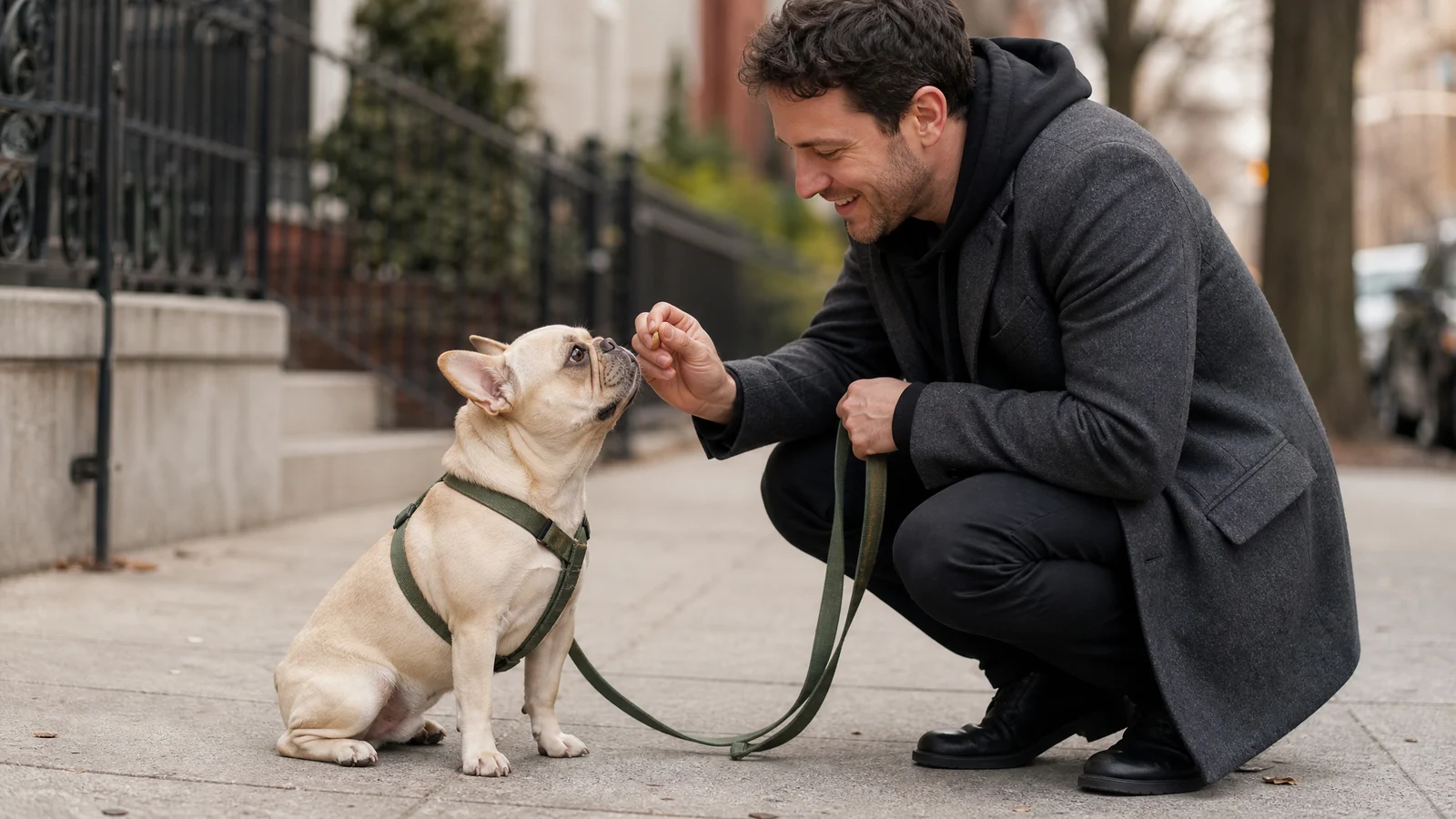
Owners describe the same scene. A puppy gets a treat for every trip outside, then leaves a puddle on the rug an hour later. On the sidewalk the same dog looks straight at you, sits down, and refuses to take another step. Then one ordinary day the accidents stop, as if they had understood all along.
That swing between charming and maddening is why so many beliefs circle this breed's training. We have trained French Bulldogs for many years and specialize in their behavior, so we have heard nearly all of them. This guide covers what you need to know about training a Frenchie, from the stubborn streak and the food question to pain that looks like attitude and the signs your plan is working. Each section takes one common belief and settles it.
A French Bulldog Is Easy to Train and Stubborn Too
The first belief is that a Frenchie is either a pushover who learns without effort or a headstrong dog not worth the trouble. The evidence supports both halves. The AKC calls them people pleasers at heart, yet says they can be stubborn and may need more training than other breeds. The parent club says they have a strong desire to please but are also very independent thinkers.
Individual dogs land anywhere on that range, from total clown to headstrong. Plan for both. Your dog wants your approval, and your dog will also weigh whether your request beats whatever else is going on. Your job is to make cooperating the best deal in the room.
Routine is your strongest tool, because Frenchies are creatures of habit. Fixed times for meals, potty trips and short practice sessions do more than any clever trick. Teach the rules you want for life from the first day, since a puppy invited onto the bed will expect the bed as an adult.
French Bulldog House Training Has No Standard Timetable
The belief here is that a smart, eager dog should be reliable by a certain age, and that anything slower means you are doing it wrong. Owners report a very wide spread, from about 3–4 months to 2 years. Several put it near 4 months, but just as many say 6 months to a year or later.

Owners who have trained other dogs, including boxers and many dogs over decades, often say their Frenchie took far longer than any of them. Slow learners commonly describe months of accidents followed by a day when the lesson clicked.
So measure the trend, not the calendar. Are accidents getting further apart? Are you catching more of them outside? Keep the schedule steady and keep rewarding, because the click often arrives without warning.
If a dog who had been reliably house trained starts having accidents again, don't read it as backsliding or a lost cause. Go back to your steady schedule, keep rewarding every success outside, and mention it at the next vet visit so a medical cause can be ruled out.
Does Praise Alone Train a French Bulldog Well?
Some people feel treats are a bribe and a happy voice should be plenty. For this breed, food is the usual route to cooperation, and many owners credit it over praise, especially for house training. A minority of dogs do the opposite and respond more to excitement and affection, so test what yours values.
Many owners credit food for house training, and the steps below are general reward-based practice. Follow them in order:
- Take your dog to the same door and the same spot each time, and stay until they finish.
- Say your marker word the instant they are done.
- Hand over the treat right away, sometimes a special high-value one kept only for going outside.
- Add praise and a little play afterward.
- Subtract the treats from the day's meals, because this breed gains weight easily.
Food speeds the lesson without replacing patience. Plenty of owners rewarded every outdoor success and still found puddles indoors for months.
Training Outdoors When Treats Stop Working
Another belief says that a food-motivated breed will work for any treat anywhere. A minority of owners find the opposite. Outside, their dogs ignore even high-value treats, toys do not tempt them, and a "leave it" backed by treats falls apart. A few add that too many treats upset the stomach.
Owners in this group say cheese is the reward that still works, including the squeezy tube kind, which can be licked in tiny doses.
Build the habit where it is easy before asking for it where it is hard. Pair your marker with food by delivering the treat within 3 seconds, repeated several times in a calm, quiet place. Then move to the yard, then the street, and shorten your expectations each step. Flat-faced dogs tolerate heat poorly, so walks and sessions belong in the cool hours. Our guide to harness and leash training a French Bulldog covers the sit-down-and-refuse moments in detail.
Is That French Bulldog Stubborn or Sore?
The costliest belief is that every refusal is attitude. A dog in discomfort often looks exactly like one who is ignoring you, and this breed has a body that invites trouble: stocky and flat-faced. Before you decide your Frenchie is being difficult, run through these signs:
- Refusing to walk, or balking at stairs and a sofa they used to climb.
- Not turning their head for a cue, or not lowering it to a treat on the floor.
- Slow or lopsided sits.
- Growling or snapping when picked up or touched along the back, which can happen even with a sweet dog.
- Breaking position to scratch, lick their feet or scoot, which can point to allergies, ears or anal glands rather than a lack of practice.
- Squinting mid-session, which is a reason to look at the eye, not a sign of distraction.
- Becoming stressed during play, which calls for an airway check.
Any of these means a vet visit first and more repetition later. Keep up regular vet visits even when training is going well, and bring up anything on this list at the next one. If it stays unclear whether a problem is medical, behavioral or both, consider a veterinary behaviorist.
This is general information, not a diagnosis. Your veterinarian is the right person to examine a dog whose movement, mood or habits have shifted, and to advise on treat amounts for your dog.
A Small Body Still Needs a Full Training Plan
People assume a lap dog under 28 pounds can skip the work. Frenchies have big personalities, and a fair amount of training is what turns them into civilized companions. Because Frenchies tend to be very open to strangers, greeting manners with four feet on the floor deserve early practice and rewards. Our look at French Bulldogs as family dogs shows why everyone in the house should use the same cues.
Keep early lessons low-impact: name response, sit, settling, crate comfort. Strenuous running and jumping wait until at least eight months and up to a year, while the joints develop. Puppy classes help with socialization, and your vet decides when your puppy is protected enough to start.
Be persistent, not forceful. A trainer who lives with three Frenchies says you need to be persistent, and that means short, cheerful sessions repeated until the habit holds. Make the work a game and pay in food, with play and attention as extras. Keep your own signals clean too, since a keen Frenchie can read a stray hand movement as a cue and add a jump or spin you never requested. For the full order of steps, see how to train a French Bulldog.
Signs Training Works and When to Get Help
We reviewed 1,329 French Bulldog owners' first-hand accounts, and the lesson holds: this dog is neither easy nor impossible, but a willing learner with a mind of their own. Reward cooperation generously, keep the routine steady, and keep checking that nothing hurts. You are on track when you see these:
- Accidents get further apart, even if progress comes in sudden jumps.
- Your dog checks in with you, or offers a sit, when a treat or a game is likely.
- Cues work in a second room, then outdoors, even if only for your best reward.
- Sessions end with a relaxed dog who settles easily.
Ask for professional help when behavior shifts overnight, when your dog growls or snaps at touch, when refusals come with stiffness or squinting, or when accidents persist well beyond adolescence. Start with your veterinarian. If the cause is still unclear, a veterinary behaviorist or a reward-based trainer can take it from there.
 BehaviorCommon French Bulldog Behavior Problems and Why They Happen
 BehaviorFrench Bulldogs in Apartments: Alone Time, Clinginess and Neighbors
 Puppy trainingFrench Bulldog Puppy Biting: Teething, Nipping and When It Eases